Why part-time childcare is so hard to find
For parents and for nannies: why three days is so hard, and what a second family changes.
A family needs three days of care. A nanny needs five days of work.
Both are reasonable. That is the whole problem.
If you’ve looked for part-time care, you know how it goes. The search that should be easy isn’t. Or someone wonderful says yes, and a few months later takes a full-time job.
If you’re a nanny, you know the other side. A lovely family, a fair rate, and a week you can’t live on.
Nobody here is doing anything wrong. And there is a way to make it work. It takes a second family.
If you’re a parent
You have good reasons for wanting part of a week.
You work part-time, or you’re home two days. Your child is at preschool until noon. A grandparent has Mondays. You’re easing back from leave and aren’t ready for five full days.
So you need Wednesdays. Or three mornings. Or every afternoon after preschool.
Or it’s the cost. You want care at home, from one person your child knows well, for the days you need it. Many families can’t pay for five days when they need three.
And whatever you need now will change. A new baby. A new school. A new job. Part-time care fits a season, and seasons end.
If you’re a nanny
Maybe three days is what you want. If you need a full week, three days is a week with two days missing.
You still need the rest. That means a second family whose days fit around the first, close enough to reach, starting about when you need them to. Until you find one, two days of your week earn nothing.
So you ask the plain questions. Are these hours guaranteed? Are they the same every week? What happens to my week when this family’s plans change?
Often the sensible answer is the full-time job. Even when you liked the part-time family more.
The rest of the week
The days one family can’t offer, another family may need. Some nannies already look for exactly this: two families whose days fit together. Some families post for it too. Finding each other is the hard part.
Put the two together and you have a nanny share: two families, one nanny, and a week that can work for everyone in it.
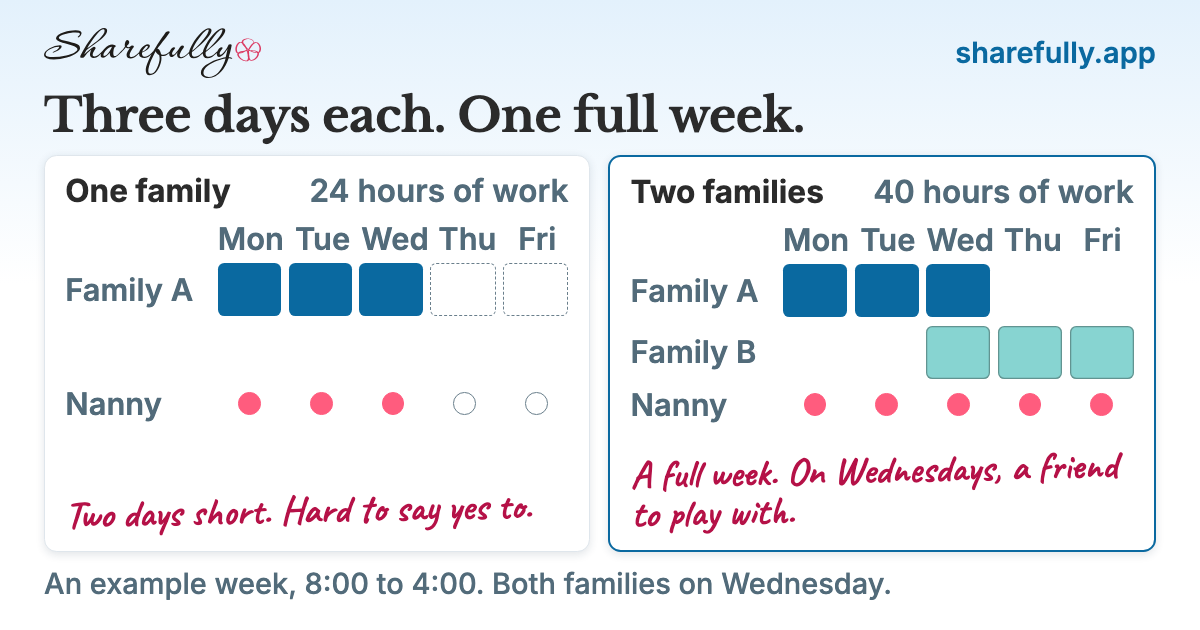
Say one family needs Monday to Wednesday, and another needs Wednesday to Friday. Apart, each is offering three days. Together, they are offering five, with one day in the middle when the children are together.
Here is what that changes.
For nannies, a full week. Five days from two families who planned it together, in place of two part-time jobs you fit together on your own. And when one family’s plans change, the other is still there while you all work out what comes next.
For families, backup you can plan together. A share doesn’t come with a spare nanny. It comes with another family who knows your child, your routines, and the person who cares for both children. When someone is sick or a day runs long, you have people to make a plan with.
For children, a friend beside them. On shared days there is someone to take turns with, argue over the blocks with, and miss on the days apart. It is still care at home, with one familiar face.
For everyone, room to change, together. One family wants another day when work picks up. The other wants its afternoons back when preschool starts. In a share, that is one conversation among all of you, and what happens to those hours is part of it. The share can change without ending.
Sometimes the second family is already there. A nanny who brings a child of their own takes part twice: as nanny, and as one of the parents. The rate is still something to agree on together.
What it asks of you
A share is different work, and there is no less of it.
First you have to find each other, and the days have to fit. Ask where you already trust people: a nanny you know, a neighbor, the parents at preschool pickup. Local parent and nanny groups are another place: families and nannies post the days they have and the days they need.
Then all of you, nanny and families, have to agree on things one family never has to think about. Whose home, on which days. Which hours are guaranteed, and what happens when one family is away. What an hour pays when both children are there, and what it pays when only one is.
If you’re a nanny, a share asks more of you too: two families to keep in step with, often two homes, and on shared days, more children at once.
Ask about nanny share pay in almost any parents’ group, and someone mentions the two-thirds rule: each family pays about two-thirds of the usual rate. A nanny at $24 an hour on your own costs each of two families $16, a third less. Hourly pay for the share is $32, a third more.
That is for the hours the children are together. In the example week above, that is Wednesday. The other four days are one family’s own hours.
One hour is tidy. Real weeks rarely are: one child goes home after lunch and the other stays. Nobody wants to be the one to bring up the math.
Start with one hour
Thinking of a family, or a nanny, who might have the rest of your week? Send them this page. It’s an easier way to start than “so, how should the pay work?”
The Fair Share Rate Calculator by Sharefully works it out, one hour at a time. Start with the rate for one family. Add a family, or a second child. See hourly pay for the share and each family’s part.
It’s free. You put in your own numbers. You don’t need the second family yet: try it with two families, and you’ll have numbers to start the conversation with.
When the whole week has to add up
One hour is one thing. A real week is another.
Sharefully is the app for the rest of it: each handoff, the hours, and each family’s part of every week. Sharefully is still being built. Leave your email, and we’ll let you know when it’s ready to use.
Built from eight years of nanny sharing. Sharefully is from Charlotte, NC.